The reliability of size estimations by UFO witnesses is a difficult question – we know that witnesses misjudge size, but by what factors? The author has carried out experiments with several groups of people to evaluate deviations of real apparent size in all sexes and age-groups.
The Question
We always run into problems when, during a UFO investigation, an observer
is asked to guess the size of the object he has seen in the night sky. Some witnesses give its size in meters to
emphasize how strange it was. They tell the investigator that it was as large as the full moon
or it was
50 m long.
But no one is able to estimate the real size of a night phenomenon when it is not known what it
was or without a known thing to measure the UFO against. It could
have been a rather small object very close or a considerably larger object in a greater distance. In both cases,
it would appear to the observer as something of the same size. Only when a comparison is possible, for example,
when the object is in front of a forest, the size can be calculated. In normal sightings in the night, the investigators generally have no
chance to gauge its true size, and yet they would want to have an idea of the size of the object observed.
It is helpful to document the optical impression the witness had as precisely as possible. In order to do this, the investigators of the GEPn1GEP is the acronym of Gesellschaft zur Erforschung des UFO-Phänomens (Society for the Study of the UFO Phenomenon): https://www.ufo-forschung.de/ ask for the apparent size of the object. The questionnaire contains an item to do this, and a control item, to which we will come back later. The answer is supposed to give an idea of the observed object. But – how reliable is the information the witness gives about the apparent size of what he or she has observed?
In a few cases, when the height of the cloud cover or the observational angle were known, and the object definitely was in or below the cloud cover, the apparent size allows conclusions as to the real size or rather the minimum and maximum diameter of the thing that was seen.
But more often I found that the apparent size was estimated to be far too large by the observer. Some witnesses gave sizes which, if correct, would mean that the object observed would have blocked their entire field of vision! With the 57-cm-test (an object, for example a button, is placed at a distance of 57 cm from the eye of the witness – would it have covered the UFO?) or a test using a known object at outstretched arm length I heard size estimates that were manifold higher than they should have been.
I very soon realized that the estimates the witnesses make have to be reduced considerably. Other UFO researchers have confirmed this.
But by what percentage or amount do we need to reduce the estimates? I wanted to gain more precise figures by a statistical analysis of estimates of the apparent size of the sun and the full moon. The full moon and the sun, after all, are often observed. I thought that witnesses would be able to pretty precisely judge their apparent size.
I established a questionnaire and – with the help of the Mannheim-based group CENAP – asked relatives, friends, acquaintance, neighbors und visitors to our lectures to tell me the apparent diameter of the moon and the sun. The subjects had to remember how both bodies looked, and then stretch their arms, holding a folding rule, and say how big it was. The questionnaire also recorded the sex and the age of the person.
The Results of the Study
All in all, we asked 238 people, 146 male and 92 female. The age distribution is shown on Figure 1:
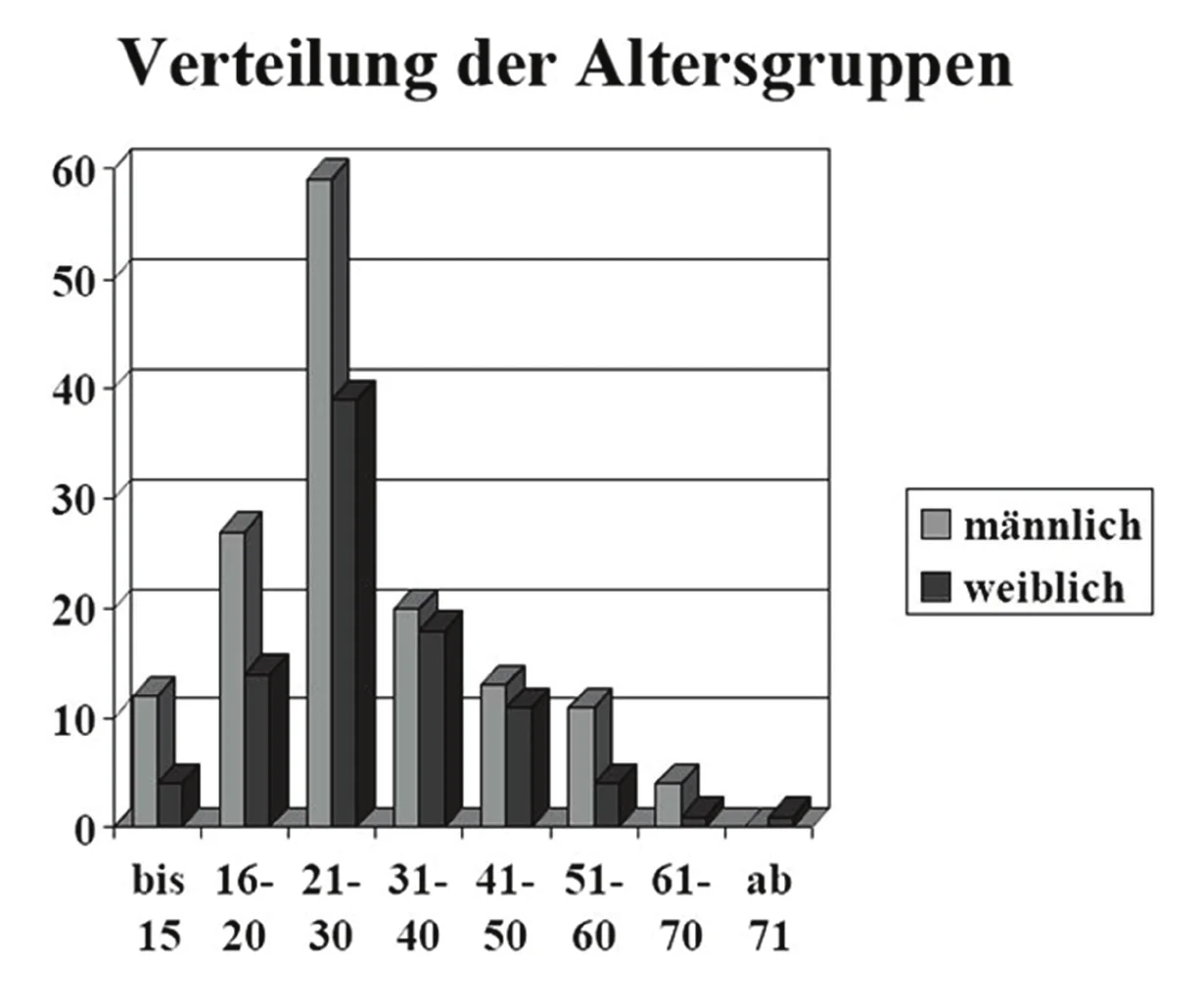
It is evident that not many people were interviewed in certain age groups for a more thorough statistical analysis. Not all results will therefore be representative. It is also known that the full moon can appear to vary in size against the night sky. It looks larger close to the horizon than high in the sky. This well-known perception error (the size does not actually vary), however, can be neglected given the expected differences in estimates. The following statements are not statistically precise, but they show general tendencies.
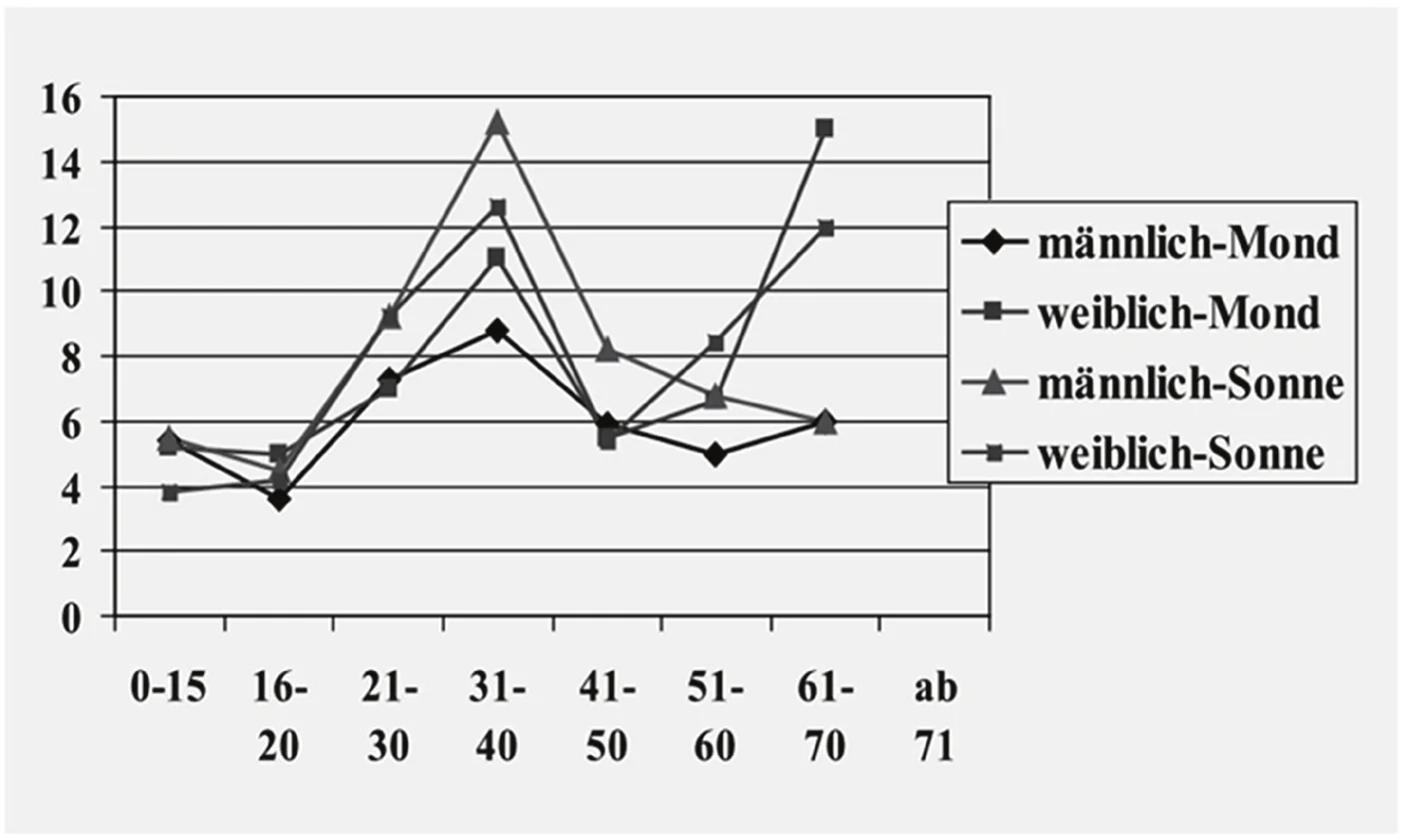
Figure 2 shows the relationship between the age groups and their average diameter estimates. In the age up to 20 years, the values are similar, but there is a major difference up to the age of 40 years. We see that the male subjects tended to grossly overestimate the size of the sun, but were lowest when it came to estimates of the size of the moon. This may be the result of the bright sun appearing to be larger to males. Women also show a certain tendency for overestimating the size of the sun. If these figures are confirmed by a larger number of subjects, we could possibly conclude that the age group between 20 and 40 years generally tends to judge the apparent diameter of bright objects larger than that of less bright objects. At ages 41–60, both sexes estimate similar values for the diameter of the sun, though males tend to guess higher values. With increased age, males tended to judge better than females. Those informants from 61 to 70 again approached the values given by those of ages up to 15 years.
We can also see that the estimated sizes start at a diameter of 4 cm. However, the actual apparent diameter of the full moon and the sun is at 0.5 cm. The diagram shows how much the size is estimated above the real value.
Looking at those diameters the different sexes most often guessed, we see that men generally reported moon sizes of 1.6 to 2 cm. The sun was judged to be somewhat larger, between 2.6 and 3 cm. We have a similar situation with the female respondents. Up the size of 3 cm the respondents still gave several intermediate sizes, after that, only round figures.
Using all data (Figure 3) we see that of the 238 people interviewed only 8 gave an estimate of numbers up to 0.5
cm, and 37 people guessed at values between 0.6 and 1 cm. That means that only 20 per cent of all people who took
part responded with an estimate below 1 cm. Almost 32 per cent gave values between 2.6 and 3 cm. 91 people (or 38
per cent) guessed values well over 8 cm. I have heard figures of 1 meter! I assume these were people who just
could not understand what I wanted them to do. Some put the yardstick away and said, I do not need such a
help
, while they attempted to estimate the diameter with both arms outstretched – which resulted in grossly
overestimated values.
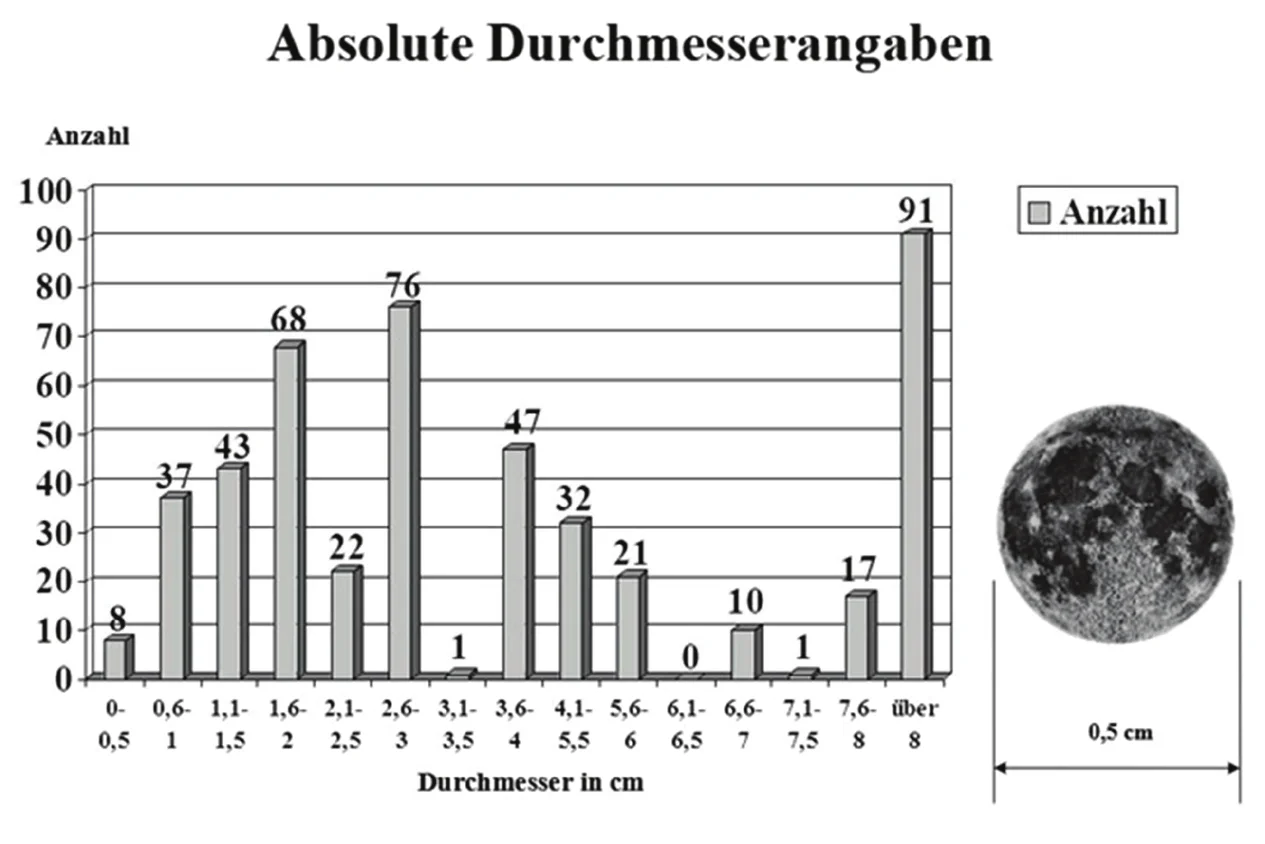
Of the 238 people 32 gave the same value for moon and sun, even if the guessed wrongly. The moon on average was estimated at a diameter of 7.05 cm, the sun – with an average of 7.98 cm – slightly larger. Combined, this results in an average of 7.5 cm. This is 15 times of the real 0.5 cm. We can see that estimates of size which UFO witnesses tell us are not accurate.
What can we conclude from this exercise? First of all, our inquiry has shown that bright objects will be judged larger than darker objects. This had already been known in the psychology of perception as irradiation illusion. A light patch on a dark background looks larger than an otherwise identical dark area over a light background. I have further concluded that the apparent diameter of the relatively well-known and often seen celestial bodies such moon and sun are judged, on average, to be 15 times larger than they actually are. Obviously, we have to ask ourselves how far out estimates are when we are dealing with an unknown object seen only for a very short period of time. One feels that the errors may be even higher. And the longer the time that has passed between the observation and the investigation, the more uncertain the estimates will be. The only exception will be those cases where the witness has actually noted parts of buildings or of the landscape and judged the apparent size in comparison. This can also be done on field investigation trips.
I do not conclude that the size estimates we hear from witnesses should automatically be reduced by a certain factor. However, the result of this study should make us field investigators help consider the size estimates critically. The GEP has added a control item asking for the apparent size of the full moon to its questionnaire, in order to judge estimation errors by individual witnesses. In field investigation, one can ask the observers to judge certain features of the landscape. Conclusions from a sighting report should always be drawn keeping these facts in mind.
(Translated from German by Ulrich Magin).